Thursday, 19 May 2011

Back in the Minch

Hello all,

Typically, as we have had 2 days off, I have managed to fill my time so successfully that I have neglected my blog. This has essentially been a weekend for me, as I woke up wednesday morning and turned up for my 4am shift to find the ship rolling all over the place and none of the night shift in the main lab where they should be. I finally found them all in the bar: they had been there since 11pm when the captain had made the decision to run for cover and we were heading full speed through increasing seas, the 9 hour run to Lewis and the shelter of the bay just off Stornoway. It was very surreal to be sitting in the bar and drinking tea and eating yoghurt for breakfast while people were finishing up their bloody marys and beer cans. And with that the day was given over to rest: no obligations to be on call. Inevitably this meant I was more than able to fill it with books and films and playing trivial pursuit.

We were banned from the deck as the waves were sloshing all over it, so I took a couple of pictures from my porthole to evidence the ride. It really wasn't bad, although I did have to wedge myself diagonally in the shower cubicle for some stability and I did go into the galley to find the contents of the tea and coffee fridge and icecream freezer all over the floor, minus that it was pretty easy to deal with.

We then found ourselves in Loch a' Tuath (as my map reliably informs me) just off the coast of Lewis at Stornoway. The wind was still whistling through but the ship was steady as a rock, which was quite a change. So today, I slept in til 6am, finished a series of the wire and then decided to take in a little air which fair lept through my nostrils when I got out on deck, but it was wonderful to clear out the cobwebs and had a great view of Lewis with the hills of Harris just visible in the distance. There was also a brief sighting of a dolphin during the day but by the time I'd got my camera and wipped out on deck I saw it pop up only once before it was gone, so no pictures this time.

After a day of concentrated rest yesterday, I also felt more productive today so I dug out the hard drive and found some videos to work up from the Polygonal Faults where we will be heading for a repeat visit after the Darwin Mounds. That is now all set up to get stuck into during my down time on shift again (provided the weather is conducive to watching the camera bob around under water!).

Our PSO (Principle Science Officer) was also feeling productive and yesterday called around some agencies to see if they wanted any survey work done in the Minch as we were sheltering here. So so far we have also acousticly surveyed the area of coast just south of Stornoway where apparently there is a borehole that BGS (British Geological Survey) would like a better map of, tonight we are multibeaming an area of reef in the middle of the Minch for SNH (Scottish Natural Heritage) and tomorrow we may even do a ROV dive there for them too- all just because we're here, bored, and have all this paid for equipment sitting around. Good work methinks.

While yesterday the rumour mill was saying we may be in the minh until Saturday, perhaps even Monday before we can return to the Darwin Mounds, today it was a different story. When I did my second check in mid morning today, I was told that we were off to the Mounds after lunch to catch a weather window for a bit more work, we'd then sit out the next rough patch before the next weather window as there appeared to be missed opportunities to get stuff done between the bad bits. However by lunchtime priorities changed, the weather window narrowed and we decided to go to ullapool and pick up a spare part ordered yesterday and amazingly arriving a day early today, meaning that we would hang around the Minch until late afternoon tomorrow, before heading back out to the Mounds in the evening, bumping through the rough for 9hrs to make the next weather window on saturday morning (Thus the multibeam tonight and ROV tomorrow for SNH). So fingers crossed the rough stuff ain't too rough and the weather window does what it says it will!

Right I'm off to bed again. It's after 10pm now, and while I am allowed to sleep in tomorrow, I am planning on getting up at 6am so as not to get too much out of the rhythm.

More anon (probably tomorrow!)
Bex

A little idea of what my cabin looks like taken with my phone camera, also note the angle of the bed relative to the dangling and therefore verticle curtain. This was the level of roll we were getting on our way through the storm to Lewis.

Above: a couple of pictures out of my porthole on the journey from the Darwin Mounds to Lewis, and Below: the much calmer conditions in the bay sheltering behind Lewis (also through my porhole with my phone camera)

Tuesday, 17 May 2011

The calm before the storm

Today was full of the same stuff (they mostly will be, it's just what we find out by doing the same sampling methods that will make days stand out). Today's stand out science was purely down to the accuracy we are managing to get. Dangling something on the end of a wire a kilometer below the boat and manouvring the vessel in order to drop the piece of equipment within 3m of the target we planned- quite impressive! Consequently we managed to drive a piston core through a mound which is something that has not been done before and which will help a lot to answer questions as to how they were formed and why they are there (which is what excites us scientists).

Really though the whole day has been overshadowed by the expectation of this storm. It had initially been expected earlier in the day but now we are expecting it tonight and after a day of ROV box core and piston core, the first two were on flat sunny waters and the piston core was in light rain and slightly rising winds. It now looks positively grim outside with rain and grey seas with white caps, but still no pitch and roll from large swells or building seas. We are all talking about how we will cope, how bad will it be, "do we still have to get up for our 4am shift?", "lash down everything that moves, and anything heavy... what's already on the floor, can't fall on the floor!", will we ride it out?, can we work in the storm?, will we have to make a 10hour steam south to hide behind the island of lewis?

All this talk makes me almost look forward to it- but I remember what happened when my sis was looking forward to experiencing an earthquake in Chile, and look what she got. So I'm trying not to tempt fate, but it shall be interesting no matter what.

Ok off to bed again, it's not yet 8, but I have not been getting to bed until 9pm for the last few nights and sleeping from about 9.30pm until 3.30am is not my idea of enough. Besides, it might be the last sound sleep I get before the weekend....!Taken from the met office website's (http://www.metoffice.gov.uk/weather/marine/shipping_forecast.html#All~Hebrides) shipping and gale forecast, we are right on the edge of the gale warning zone, I think just inside "hebrides", although bordering "faroe" and "fair isle" which are the white boxes just north of the red area. I noticed only "rockall", the southwestern most of the group of red boxes, was the only one red first thing this morning, with "bailey", the one above rockall and next to "hebrides" where we are, was red by 10am, followed by this forecast at the end of my shift.

Incidentally, for those of you that are not british, or don't know about the radio broadcast of the shipping news on BBC Radio 4, you should really see if you can find a recording of it on the internet- it's an institution! It really sounds like code, complete gobbledygook, unless you know what it means and where the amazingly named areas refer to. What is more they are nearly always read out by a smooth voiced calm individual, and if you are listening in the wee small hours of the morning, it's the kind of thing that can send you off to sleep by the sheer smooth and uncomprehendable manner of the 5minute broadcast. There's bound to be a recording on youtube or somewhere: I fully encourage you to partake of the phenomenon!

Monday, 16 May 2011

RIP Purple Sandpiper

Well we've ben ROVing again, another long transect that my shift joined half way through, and seeing occasional clumps of live coral. We then ended it with a roam around doing some "biological tourism" taking close up photos of the corals and where they are growing and other interesting features along the way. I shall try to get ahold of something funky to show you by tomorrow. Unfortunately we ended up without the video footage for the biological tourism section as both the digital backup failed and the tape ran out without anyone remembering to change it, so we are now all instructed to set an alarm for the end of the tape, which may be a bit of mayhem but is necessary given the difficulty of having to remember 3hrs and 15mins after you start its time to change the tape! 5 people had the opportunity to remember (me included) and none of us did, so it was lucky we learned this on the non scientific transect section of the dive!

The rest of the day has been a waiting game:

-transit off to pick up autosub, 1hr,
-stand on deck waiting to spot autosub, 3hrs
-mistake someone flushing the toilet out the side of the ship for autosub, 20seconds,
-give the autosub technicians a heart attack, 20seconds,
-spot the actual autosub 200m off the stern, 30mins later,
-wait for it to be brought in, 40mins
-transit to box core site, 2hrs,
-box core goes in and comes back up, 40mins,
SHIFT CHANGE

...so as you might imagine there was a bit of boredom in the afternoon. I spent a while chasing after a purple sandpiper with my camera on deck. It didn't look very well and was all puffed up looking rather weak. Sadly an unnamed crewmember (I emphisise not I!) mistook this tiny wader for a seabird, picked it up and threw it over the side thinking it would a) fly or b)sit on the water. The fulmars were seen eating the small dead bird shortly afterwards. RIP purple sandpiper! The unnamed crew member is now feeling rather guilty!

Right I am off to bed again. 6hrs 9.30pm-3.30am is not quite enough for me I am finding so I am going to be ruthless and whip off to bed pronto. I should mention that we may be coming into some weather within the next 24hrs, we've all been warned to start prepping ourselves with seasickness tablets, so it is possible the internet will go down when we are in the thick of it. If so I shall be back as soon as it is up again, hopefully with some dramatic pictures (it'll almost be an anticlimax if this does not happen now!).

I'll write again soon.
Bex

Sunday, 15 May 2011

Another hard day of dolphins and pilot whales...

First I should mention that blogger was playing up yesterday, so here's a quick run down of events on 14/05/2011:

It started with a ROV transect in the eastern fields of Darwin Mounds, a wibbly wiggly one for 4hours, with lots of xenophyophores (see photo below) which are giant single celled organisms who roam the seabed looking like footballs of sand, licking up the organic detritus that settles on the sea floor; and patches of dead coral. Nothing much esle. So I'm chucking in a little trio of pictures from the previous ROV dive to entertain you with the octopus, below.

This was followed by a piston core again, and then a long wait as we were supposedly off to pick up the Autosub. However upon arrival at the autosub site, the machine was not at the seafloor where we expected it, it was stranded mid-water column with the inability to dive. This puzzled everyone and there was much excitement that there was the possibility it was tangled in a longline (set fishing lines which can be kilometers long) and talk of the ROV having to go and look for it and cut it free. This all ended up being too much fuss as it surfaced fine, however the reason for the midwater tantrum is still unclear and hopefully the next time its in the water (tonight) it'll be right as rain again.

One other thing of note happened yesterday- I learned of the birth of one Noah Auburn, born on friday 13th to our old friends Lee and Sarah in Plymouth. I am extatic for them and am eager to meet the wee guy when I get home. So exciting!

Ok on to today.

Today has been non-stop since the word go. I arrived to the ROV sitting on the bottom and just about to start it's 5hour transect, so I immediately plugged into my digital logging role, swapping with a colleague half way through to sit in the "ROV shack" and keep a written log whilst clicking a mouse to activate the ROV camera every 30seconds throughout the transect.
I enjoyed this immensely, particularly as there was actual live coral to bee seen on this dive, one clump unfortunately wrapped in fishing net, but many looking healthy. However this is an area where the reef is quite patchy so the sight was not nearly as spectacular as can be seen in the Rockall bank cliff edges where we will be heading next week so watch this space for some of those pictures (and I'll try to get ahold of some of these ones once they've been processed- the ROV guys had been up for 30hours when they went to bed at the end of their transect, so we'll forgive them for not having sorted out pictures immediately!).

Incidentally this ROV transect was interrupted by a visit from a pod of pilot whales at about 5am. I was left to my logging as the lab emptied out onto the deck with the cameras while I cursed them. Then a kind sole came back in and relieved me so that I could catch a few snaps too before they disappeared.

Just after the ROV landed back on deck we had our second cetacean sighting of the day- a pod of white sided dolphins passed by, and while I was snapping away, unfortunately in my haste I had flicked the manual switch on my camera which left every photo over exposed with a black blob where a dolphin should be.

Back to work and it was piston coring time. This time we were attempting to slice through a mound and see what it's mad of. However targetting a 50m area (however big that sounds) by dangling a tube on a wire from a ship 1km above is not very easy, and while there were a couple of tiny fragments of coral in the core, it was clear we had missed the mound, so they are trying this again later.

One new job today- the box core! Some marine biologists at Heriot Watt University in Edinburgh could no longer make it on this cruise but charged us with gathering a few samples for them. They are looking for preserved specimens of live coral samples and their associated wildlife, so the box core does what it sounds like, its a square 50cm sq that is dropped on the seafloor, with a door shutting beneath it essentially bringing up a neatly boxed portion of the seabed with anything living on top of it still pretty much intact.

Awaiting the arrival of the box core from the seabed was thankfully made less boring by the reappearance of pilot whales and the white sided dolphins all at once. The pilot whales came right up close while the dolphins did acrobatics in the background, clearly feeding on a ball of fish as gannets dived around them.

So as you'd expect I have a couple of pictures for you. And with these I bid you adieu as it is way past my bed time (we had a "watch meeting" in the BAR at 7, which was actually just a have a glass of wine and wind down social. Consequentially it is already 9pm!)

P.S. I have been thinking of Luke and his parents and my parents today who have all been having lunch together without me - it's a wierd thought as I bob around with whales and muddy cores that life continues in a much more normal fashion a few hundred miles away.A box core coming out of the water, you can see that in the middle, there is just a box!Brian Bett, one of the biologists on board, holding a xenophyophore that came up in the box core. It's pretty big for a single celled organism, no?
The octopus from the first ROV transect. Isn't it a beaut!
A pilot whale having a little look around (actually there are 2 in this picture)

Mother and baby pilot whales
A bit of a fluke (tail) kick.
A bemused fulmar with a pilot whale passing by.In the distance the white sided dolphins were jumping about while gannets circled and dived alongside. Classic sign of a shoal of fish which have been herded to the surface by the pod of dolphins to make them easier to catch (this kind of shoal of fish is called a bait ball, purely for the amount of predatory attention it attracts).

Friday, 13 May 2011

Zonked

Hello all, I'm afraid this is going to be a short post today as I am completely knackered after a long day of actually doing stuff!

It doesn't sound like much, but today I helped with 2 piston cores and 1 ROV transect.

OK, quick translation here: a piston core, as far as I can gather is a long metal barrel with a piece of plastic drainpiping inside (long is 9m in this instance) this is lowered on a cable with a piston mechanism at the top of the tube with a trigger lever set in the off position by a second short dangling metal barrel which reaches the seafloor first, releases the leaver which triggers the piston which essentially drops the 9m barrell with force into the sediment. The result is that you pull out the plastic drainpiping (once back on board) and chop it into managable sections all filled with sediment (here gooey clay mud), which are then sealed on the ends then split down the middle so that you get a manageable cross section of what the sediment layers look like 1000m under the sea. We were looking for patterns of "holocene sandy cordite"- again I needed translation here- the geologists wanted to know about the speed and positionin of the deposit of sand around this bay-like deep spot, which is affected by 2 different watermasses who changed their sedimenting pattern in the holocene era. They were curious as it looked like it graded really fast over a very small area, from previous cores, so they wanted to see whether this was actually the case. (phew!)

After 2 of those, getting very muddy, and very wet thanks to the rains from greenland deciding only to fall the 2 times we had to be on deck playing with mud (- that was cold!), I was then charged with the digital logging of the ROV transect. This was essentially a camera being sent for a drive over the Darwin Mounds to see if there is any coral left on them. The mounds are 1-5m tall and 60m across and really just look like pimples on the seafloor. This is mostly interesting to the geologists as they are debating as to how they were formed, but we also want to know about the corals that live on these mounds. They were discovered 10 years ago by some of the people who are on this boat, and as they had coral on them there was a big rush to protect them as interesting features. However as the protection proceedure took a while to come into place and had hit the news at the time, a month before closing to bottom trawling the fishermen came in and ransacked the place, knowing only that it is a reasonable fishing ground that they soon cannot access. So our secondary purpose is to see if there is anything left here of the corals and of the mounds. And if they have been ransacked by trawlers, after 10years of closure is there any regrowth, if so where are the young corals coming from. The ROV can show us pictures of what it looks like down there, and it also has a manipluating robot arm that can be used to pick up samples (I'll show you some pictures of the fancy plastic sample box contraption tomorrow).
The result was that we saw mostly sand with these interesting creatures called xenophyophores all over it (xenophyophores are giant protozoa - massive single celled organisms that are 10cms across and just look like footballs of sand lying on a flat sandy surface), which was expected on the tails of the mounds (the sediment build up behind each mound relative to the current), while on the mounds (we only looked at 2 right next to each other) there was lots of dead coral rubble, clearly having been trawled, interspersed with other organisms that can find hiding space amongst the debris (sea stars, brittle stars, urchins, soft corals and sponges mostly) but on the whole it looks pretty desolate. The plan is to go and look at another couple tomorrow and see if there is any coral left living. We saw only about 3 living specimens during todays 4 hour transect!

The interesting thing here, particularly for the JNCC representatives here (the government agency responsible for creating the protected conservation areas outside of the 12mile inshore limit in Britain) is whether this area is still worth protecting. And if not, how does one unprotect a protected area?!

So essentially my job during the ROV dive was to write notes to the effect of "ROV deployed" "ROV on the bottom" "sample 1 being taken" "coral rubble visibile, no live specimens" and "octopus!", which I find strangely fun, purely because I know what's going on, and if there is anything interesting to see, like the octopus, I get to see it :).

Ok, that was my "short" post for the day. Soon I shall actually give you a run down of why I am here, but first I must sleep as I might have mentioned, I am ZONKED!
Good night all.
Bex

The last few positions and the next few positions will all be up here in the darwin mounds area- essentially the most north easterly corner of the rockall trough in bay made by the Wyville-Thompson bank.

An idea of what a multibeam map looks like red is shallow down through yellow and green to blues which are deep. This shows you what the mounds look like rising slightly above the seafloor, the two pronounced coffee bean shaped mounds on the left are the ones we went over with the ROV.
Not a great picture, taken on my mobile phone. This is Becky and Tim looking at the split piston cores. As you can see, yes there is mud at the bottom of the sea!

Wednesday, 11 May 2011

Darwin Mounds Dip 1

At about 2.30ish we made it to the Darwin Mounds and our first station. As the AUV Autosub is still not in working order the first thing to be dipped in the water was the CTD or the Conductivity, Temperature and Depth sensor array, which also had attached a bunch of niskin bottles for sampling the water column and a USBL (or Ultra Short Base Line) system to keep track of it's GPS position and depth allowing one sensor to ground truth the other.

Not much else to report though. The next shift get the first of the interesting stuff- the Megacorer is going in, taking four cours of the seabed sediment which are going to be used in tests of the rate of remineralisation when fresh marked algae are added by the Aberdeen University duo. They are interested in doing this at 3 different depths and in trawled and non trawled sediment to see if there are any differences.

Once that is done (an that'll take most of the night as it's 2hrs down and 2hrs up and there'll be 3 dips done to get the 10 samples they require.) my shift only have to watch the ship mounted multibeam mapping of the area so we've been allowed a 2 hour sleep in to rise at 6am as only 3 bodies will be required for the initial processes.

Right I'm hungry! I wonder what feast will behold us this evening...

Or current position at our first station on the Darwin Mounds (Marked in green in the far North).


Manouvering the CTD array and all it's attachments.
And then the plunge :)

11/05/2011

This morning I successfully got out of bed at 4am, hopefully my sleep pattern will be fairly set for the upcoming month of 4am shifts. However I was somewhat helped along by the fact that everyone on board has moved their clocks back by an hour to synch with the GMT equipment. So my 4am is britain's 5am- not quite so unsociable for the sleep adjustment!

A roam around the ship and into the main lab saw that we were already halfway through a multibeam swath over our test area, and about 3hours away from the Darwin Mounds (check the map below for an idea of where that is). The idea was to check that the ground was fairly flat and then test the corroboration between the multibeam versus the ROV and the Autosub data.

So I got myself Earl Grey Tea'd up, donned my wet weather gear (just in case, the clouds were threatening) and headed out to the gantry above the aft deck for a view of the ROV deployment and a bit of bird spotting.

The ROV test was successful, but the Autosub was not. It never left the deck due to a software failure which they are now frantically trying to amend before we get to the Darwin Mounds, otherwise all our Backscatter and Side Scan Sonar data will not be available in advance of the ROV transects and Cores, all of which ideally need to be targeted using the acoustic data from the autosub. Fingers crossed all gets fixed soon. Meanwhile we are underway to the Darwin Mounds, eta 2.30pm.Our test site was due west of the northernmost of the Orkney Isles and North West of the island of North Rona. We are now heading futher north to the Darwin Mounds.

A view of the Aft Deck with the ROV to the right (you can just see the top of it's "garage" basket and the winch it's attached to), the Autosub dead ahead though out of sight (under the white crane rack in front of the white container dubbed the "autosub viewing shack") and some of the coring equipment stacked to the far left.
This is my montage of the ROV set up. The winch is used to lower the ROV in it's "garage" or TMS (Tether Management System) to the sea floor, then the little yellow SeaEye Lynx is driven out along the seafloor and then back again where a winch system winds in it's yellow tether and the ROV is reversed back into it's garage before being hoisted back to the surface and back on deck.

Launching the ROV are Leighton (who runs the www.RRSJamesCook.com blog) and Kelly.
The ROV and it's Garage taking the plunge.
Biologist Brian Bett watching a close up of a squat lobster (Munida rugosa) on the live feed from the ROV in the Main Lab.
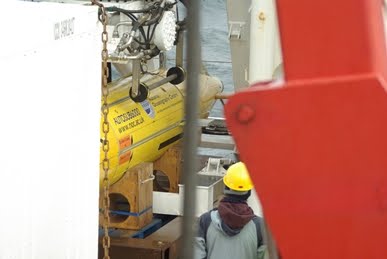
The Autosub6000 Autonomous Underwater Vehicle(AUV) which did not get tested in the end. Fingers crossed it is set to go in a few hours time.One of our constant companions out here, the elegant Gannet.We were told to expect some stragglers along the way: migrant birds often stop for a rest using ships as floating islands. This is Russel Wynn, our resident charismatic megafauna expert, holding todays straggler- a swallow, first seen on the Aft Deck but caught in the video room!